MARIANG MAKILING
There are many stories woven about this guardian spirit. Most of them deal with her helping the poor and the sick, in the guise of a peasant girl. The precious things she lend the country folk are said to be returned to her, along with the offering of a young pullet with feathers white as milk.A hunter has recounted a face-to-face encounter with the enigma herself. He was hunting a wild boar, he said, deep into the forest where Mariang Makiling lived. The boar suddenly crashed into some bushes and the hunter, fearing that he would not find it again, dived in after it. When he came to his feet he saw a small hut, and witnessed his prey entering it. He followed the boar into the hut, thinking it deserted, and then he came face to face with a beautiful maiden standing by the boar, who was meek in her presence. The maiden said “This boar is mine and you must not harm it. But I see that you are tired and hurt. “Come in, eat, and then go your way.”The hunter felt compelled to obey her. He sat down at her table, and she served him a porridge that he found was unlike anything he had ever tasted. It invigorated him, and after eating, he felt healed. As a parting gift, Mariang Makiling filled his peasant hat, called a salakot, with yellow ginger.The hunter, on his way home from the forest, found that his salakot was growing heavier and heavier, and so he broke a few pieces of ginger in half and threw some bits away. Upon coming home, he handed Maria Makiling’s gifts to his wife, who found that the salakot, instead of containing ginger, as her husband claimed, contained gold. The hunter regretted having thrown away a few bits of ginger/gold along the way.Mariang Makiling is said to be more than compassionate.
Once, there lived a young farmer who always seemed to be blessed. His fields were never touched by any calamity, and his livestock were always in good health. The people of his village say he is endowed with a charm, or mutya, as it is called, that protected him and his from harm. The young man himself was good at heart and simple in spirit. But he was quiet and secretive, and would not say much of his stranger activities, which included frequent visits into the wood of Mariang Makiling.But there came a terrible time for him and his family. War had come to his fair land, and army officers came, recruiting unmarried young men who were in perfect health. So that the young man would stay safely in the village, his mother arranged for him a marriage with a most beauteous daughter of a wealthy family. Upon finding this out, the young man became more sullen than ever.

He visited Mariang Makiling’s wood one last time, a few days before his marriage. Mariang Makiling lent him a dress and some jewelry, for his wife to wear on their wedding day. “I would that you were consecrated to me,” she said sadly, “but you need an earthly love, and you do not have enough faith in me besides. I could have protected you and your family.” This having been said, she disappeared. The young man went back to his village with Mariang Makiling’s gifts, and presented them at once to the girl he would marry.But the girl did not care for Mariang Makiling’s gifts. Instead she wore the pearls and dresses her mother had handed down.
Mariang Makiling was never seen by the peasants again, nor was her humble hut ever rediscovered.
THE LEGEND OF OLONGAPO
After updating one another, Dodong promised to visit them more often so that he can help them with their
Olongapo is a city located in the province of Zambales. It is one of the most cheerful cities in Central Luzon. It is near the Subic bay and is also one of the places which have been largely affected by the eruption of Mt. Pinatubo. This is how it got the name Olongapo: There was a lad named Dodong. He is a farmer with a wide rice field. Because of his generosity, he was well-loved by the people in his barrio. He was labeled as APO (term used for a respectable old man) and he became well-known to both the youth and the old.In the neighboring town, there was a very beautiful maiden who is very demure. Her name is Nene. Nene and Apo became very close friends though their age gap is large. One day, Nene’s family decided to relocate. This is the reason why Apo and Nene got separated.Days passed into months. One day, Apo accidentally ran into Nene in one of the town’s public places. Time only enhanced Nene’s beauty. He noticed that Nene has transformed into a full-blown lady. He offered to take her home. This was happily accepted by the maiden. “Father, mother, Apo is here. He wants to visit you,” Nene happily told her parents upon arriving home.“Dodong! How are you? We’re glad that you came here to visit us!,” exclaimed Nene’s father.
chores. True enough, Dodong went there every Saturday and he and Nene became closer. Not for long, they became lovers. This was not opposed by Nene’s parents.One morning, a large vessel ridden by drunk Spaniards came ashore. They caught sight of Nene and so they approached her. They asked something to the maiden which she did not understand. She just nodded her head. The Spaniards, thinking that Nene agrees to what they want, started to kiss and hug her. Nene screamed and asked for help.In an instant, the people called Apo and informed him of Nene’s situation. Apo was enraged and he attacked the Spaniards. The armed foreigners struck Apo and killed him. They slashed their head and hanged it on a bamboo pole to serve as a warning to other natives.”Ulo ng Apo! Ulo ng Apo!” (head of Apo) the children repeatedly shouted. The Spaniards thought that this is the name of the place. Time passed by and “ULO ng APO” became OLONGAPO. This is now one of the most controversial cities in Zambales, Central Luzon.
THE LEGEND OF MAGAT RIVER
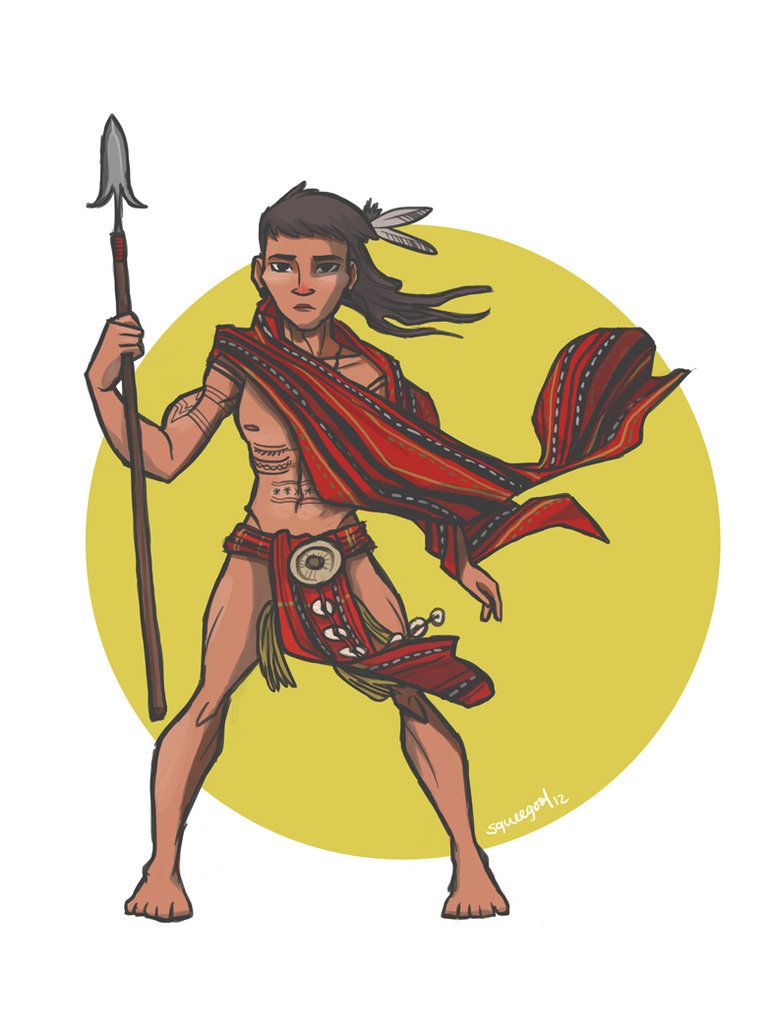
A long time ago, there lived in Bayombong a tall, handsome man called Magat. He was young and strong, and fast as a hunter and sure in his spear shot. He could run as fast as a deer and strong as he was, he could down a bull with ease. He was strong-willed and obstinate but he was also kind and gentle. Except for a few who envied him his prowess, everybody in the village loved and respected him.
Magat loved outdoor life, and roamed in the forest surrounding the struggling settlement. One day, fired by adventure he wandered farther than usual. Soon night came. Being far from home, he kindled a fire in his crude, primitive way. he lay beside the fire and fell asleep.Early the next morning, he pursued his solitary way. Finally he came upon the largest stream he had ever seen. He stopped and crawled noisily to the bank of the river near the fall. Upon parting the tall grasses he beheld a lovely sight just across the stream-beneath the shade of the outspreading branches of the big balete tree was a very beautiful maiden. She was bathing and was nude from the waist up. She was the most beautiful woman Magat had ever seen and he fell in love with her at first sight.
From where he was hiding, Magat’s attention was attracted by a silent movement on a spreading branch; Magat saw a great python, coiled around the branch, which was ready to attack the beautiful woman. He jumped backward. The noise he made drew the attention of the maiden, who, turning around, saw him poise a spear. She mistook his attitude for hostility and ducked under water. Just as the python sprang, the spear flew from Magat’s hand. The snake was struck right through the eyes and brain.The next moment, Magat was in the water and carried the beautiful Maidenashore. She struggled a little but did not scream, as she modestly tried to cover her body with her long dark hair. Magat pointed to the writhing python. Upon seeing it, she screamed instinctively and drew close to Magat, who put a protecting arm around her lovely shoulders.Gratitude and admiration were all over her pretty face.Magat picked up his broken spear and went back to the young woman. They wandered about in the forest. Under the spell of nature, Magat asked the woman to be his wife; the woman, after making Magat promise in the name of the great Kabunian not to see her at noon, consented.He brought her home and made a cozy room for her. Everything went well and happily for a while. But the passing days, his curiosity mounted more and more and at last, it grew out of bounds.
Sadly, Magat buried the dead crocodile in his front yard. worn out by grief for his lack of fidelity to his word and over the death of his lovely wife, he drowned himself and his miseries in the same stream grew into the mighty troublesome Magat River.
One noon, he broke his promise and broke into his wife’s seclusion. In his wife’s bed of soft leaves and grasses he beheld a sight that chilled his heart. A great crocodile was lying on his wife’s bed. Believing that his wife had met a horrible death, he rushed to the kitchen, fetched an ugly weapon and returned to his wife’s room. He raised his weapon to kill the crocodile when suddenly he saw his wife on the bed instead of the crocodile. His wife was dying. “You broke your promise. I can no longer be happy nor live any longer. I must die.” his wife sobbed. Slowly life ebbed from her. On her beautiful skin, scales appeared, as she turned into a crocodile before his very eyes. That was his punishment for having broken his promise made in the name of Kabunian.
THE LEGEND OF PAGSANJAN FALLS
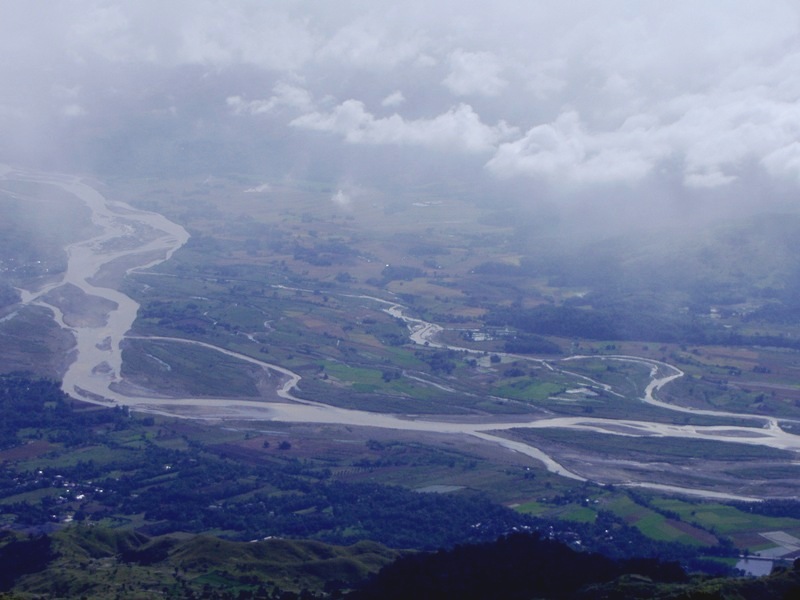
This is a folk legend as gathered from the town folks of Cavinti that tells about the falls. Long ago there were no falls. There were only the foliaged highlands and the twin rivers, Bumbungan and Balanac and the alluvial delta where the town of Pagsanjan is nestled. On the eastern bank of Bumbungan River lived two old brothers namely Balubad and Magdapio.
For many years the two brothers lived a rustic life of peace and happiness. But one day a calamity struck. A terrible drought caused damaged to the fields and death to many living things. No rain fell for many months.
Hence, both brothers suffered immensely. For days and nights they prayed for rain, but the gods did not heed their prayers. The eldest and the weakest of the brothers, Balubad eventually died of thirst.

Magdapio with a sorrowing heart buried him on the slope of the mountain overlooking the river delta. This mountain is now called Balubad. Left alone in the waterless world, Magdapio trekked to the upper region of the arid riverbed. As he reached the high rocky cliffs after an arduous journey he found no water.
In utter disappointment he sobbed bitterly saying, “Oh gods, where is the water?”. Out of desperation he angrily hurled down his big cane among the rocks. Suddenly, a spring bubbled on the spot where the cane fell. Then, rapidly it grew bigger and bigger. The fresh water roared down the canyon walls resulting to a waterfall.
For proper perspective, the waterfall known as Pagsanjan Falls is the Magdapio Falls situated in the town of Cavinti. The “shooting the rapids” adventure starts from the shore of the town of Pagsanjan and cruising along the river towards the fall.
MANGITA AND LARINA
At times of rain or in winter the waters of the Laguna de Bai rise and detach from the banks a peculiar vegetation that resembles lettuce. These plants, which float for months down the Pasig River, gave rise, no doubt, to the story.Many years ago there lived on the banks of the Laguna de Bai a poor fisherman whose wife had died, leaving him two beautiful daughters named Mangita and Larina.Mangita had hair as black as night and a dark skin. She was as good as she was beautiful, and was loved by all for her kindness. She helped her father mend the nets and make the torches to fish with at night, and her bright smile lit up the little nipa house like a ray of sunshine.Larina was fair and had long golden hair of which she was very proud. She was different from her sister, and never helped with the work, but spent the day combing her hair and catching butterflies. She would catch a pretty butterfly, cruelly stick a pin through it, and fasten it in her hair. Then she would go down to the lake to see her reflection in the clear water, and would laugh to see the poor butterfly struggling in pain. One day a poor old woman came to the nipa house and
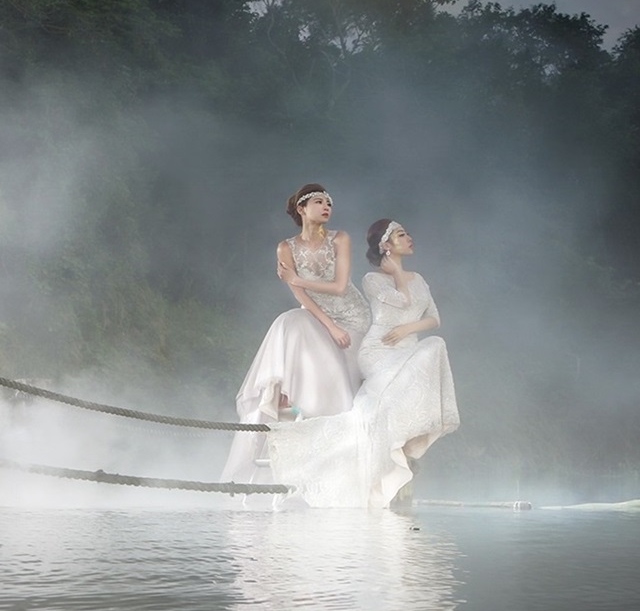
begged for a little rice to put in her bowl. Mangita was mending a net and Larina was combing her hair in the doorway. When Larina saw the old woman she spoke mockingly to her and gave her a push that made her fall and cut her head on a sharp rock; but Mangita sprang to help her, washed the blood away from her head, and filled her bowl with rice from the jar in the kitchen.The poor woman thanked her and promised never to forget her kindness, but to her sister she spoke not a word. Larina did not care, however, but laughed at her and mocked her as she painfully made her way again down the road. When she had gone Mangita took Larina to task for her cruel treatment of a stranger; but, instead of doing any good, it only caused Larina to hate her sister all the more.Some time afterwards the poor fisherman died. He had gone to the big city down the river to sell his fish, and had been attacked with a terrible sickness that was raging there.The girls were now alone in the world. Mangita carved pretty shells and earned enough to buy food, but, though she begged Larina to try to help, her sister would only idle away the time.The terrible sickness now swept everywhere and poor Mangita, too, fell ill. She asked Larina to nurse her, but the latter was jealous of her and would do nothing to ease her pain. Mangita grew worse and worse, but finally, when it seemed as if she would soon die, the door opened and the old woman to whom she had been so kind came into the room. She had a bag of seeds in her hand, and taking one she gave it to Mangita, who soon showed signs of being better, but was so weak that she could not give thanks.The old woman then gave the bag to Larina and told her to give a seed to her sister every hour until she returned. She then went away and left the girls alone.Larina watched her sister, but did not give her a single seed. Instead, she hid them in her own long hair and paid no attention to Mangita’s moans of pain. The poor girl’s cries grew weaker and weaker, but not a seed would her cruel sister give her. In fact, Larina was so jealous that she wished her sister to die.When at last the old woman returned, poor Mangita was at the point of death. The visitor bent over the sick girl and then asked her sister if she had given Mangita the seeds. Larina showed her the empty bag and said she had given them as directed. The old woman searched the house, but of course could not find the seeds. She then asked Larina again if she had given them to Mangita. Again the cruel girl said that she had done so.ht, and when Larina could see once more, in place of the old woman stood a beautiful fairy holding the now well Mangita in her arms.She pointed to Larina and said, “I am the poor woman who asked for rice. I wished to know your hearts. You were cruel and Mangita was kind, so she shall live with me in my island home in the lake. As for you, because you tried to do evil to your good sister, you shall sit at the bottom of the lake forever, combing out the seeds you have hidden in your hair.” Then, she clapped her hands and a number of elves appeared and carried the struggling Larina away.”Come,” said the fairy to Mangita, and she carried her to her beautiful home, where she lives in peace and happiness.As for Larina, she sits at the bottom of the lake and combs her hair. As she combs a seed out, another comes in, and every seed that is combed out becomes a green plant that floats out of the lake and down the Pasig.And to this day people can see them, and know that Larina is being punished for her wickedness.
THE LEGEND OF APO LAKAY-LAKAY

One day, the father coming home from an abundant catch came across an old man. The old man asked if he could spare a bite from one of the fishes he would cook as he was starving. The father laughed off his request. The old man said “You’ll regret it if you will not!” but he continued on.
That evening while the couple were cooking, an old lady came knocking at their door and pleaded for a bite of fish they were cooking. The wife yelled at her exclaiming they have nothing tho give her. She gave a warning that they would regret it if they won’t give here even a bit. She went away empty handed.
By dinner time, they found out their son was missing. They searched out of the house and asked their neighbors for help. It was during sunrise when they found their son across the waves in the east. They ran despite the tiring night long search but was heart broken to find their beloved son turned to stone.
The couple went back to their home weeping. The wife blamed her husband for being greedy and useless. Suddenly her husband turned into a stone in front of her. Slowly she noticed the waves caught her feet and slowly she turned to stone as well.
On this day the the Two towering rock formations at Taggat Lagoon are known as Apo Lakay-lakay (Old Man) andApo Baket-baket (Old Woman). Their son Ubing-ubing (Child) is found of Sentinela Beach across Claveria Bay.
To make up for their mistakes, the mountain and the rocks there has been protecting their village from storms and always have abundant catch. But whenever boats pass by these rock formations, they would give offerings to the sea or else their boats would be wrecked by the rocks and the waves
PRINCESS URDUJA
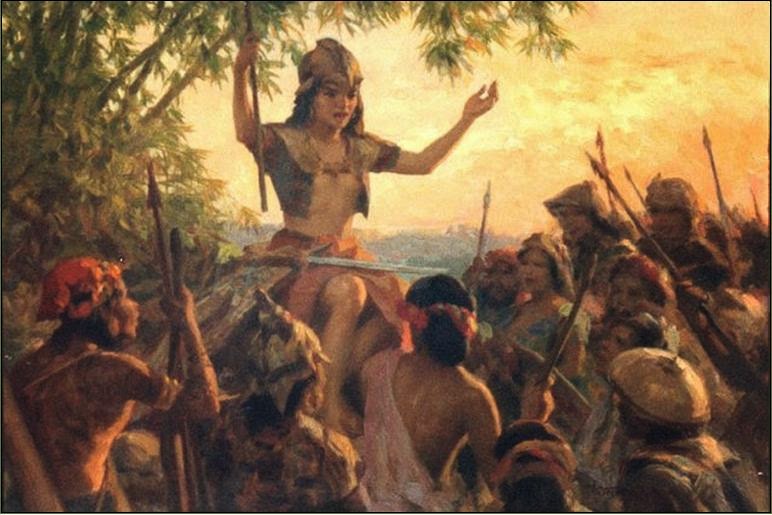
With the rise and prominence of the Shri-Visayan Empire in the 6th to the 13th centuries, political dominance by conquests and wars took place. By the series of wars , the men population was depleted. In the course of time, the women folks by necessity in the scarcity of available men, had to take the place of the men in the battlefield so that they came to develop the high art of warfare to preserve their political state.About seven hundred years ago, when Pangasinan was a kingdom, there lived a famous woman ruler in that dominion. Young, beautiful and well-educated, Princess Urduja was reputed to be a good warrior who had personally led her soldiers to the battlefields. Her retinue consisted of women skilled in arms, in riding horses and with well-built and well-developed bodies, prodigious strengh and masculine physique dubbed as Kinalakian or Kalakian or Amazon.
To the Pangasinan court many a suitor came, seeking for the hand of fair Urduja. The Princess said to them, “I will marry only the man who can defeat me. My husband must be braver , stronger, and wiser than myself.” As no one qualified to her demands, she remained unmarried all her life. For no one wished to be beaten by a woman. When her mother died, she became the ruler of Pangasinan region. Her bravery and skill were known far and near. She ruled her people well and wisely. Like the famous Amazons of old, Princess Urduja was not only intelligent, beautiful, and dominant, but also the very personification of kindness and virtue. One of her policies was to introduce the best of other countries adapted to her own. She was a woman who was interested in foreign affairs for the good of her own kingdom. She liked to hear the tales about India, the Pepper Country.An Arab traveller, Ibn Batuta, on his way to china, stopped at her kingdom. According to her custom, she invited the ship’s crew to a banquet. The Arab refused to go because he could not eat their food since they were “infidels”. The princess was offended and summoned him. He was surprised at what his eyes witnessed and his ears heard. For the Princess was robed in her richest and best, decked with precious stones and surrounded by brave and loyal men and women. She talked to the visitor in Arabian. This alone proved that she was a Moslem, knew her Koran, and therefore knew Arabic, she told him: “You, Priest, I have had you brought here by my guards because, of all of your ship’s company, you alone scorned my invitation. You told your Captain that we, people of Northern Luzon are infidels, and that it would be against the prophets law for you, a holy man, to eat our food.”
“You behold about me, seated around my throne, the elderly ladies who are my counselors. Do their chairs of sandal-wood, does my silk canopied and gold plated throne, suggest the court of a barbarous people?”
“I greeted you with the usual salutations of courtesy in the Turkish tongue, and had one of my attendants fetch ink and paper so I could write for you in Arabic characters that you recognized as the name of the merciful and compassionate God. Are such tokens of culture common among barbarians?”
When my father Dalisay, the aged king by whose name you call his kingdom, was a much younger man, there visited here a priest of another faith from far distant Europe. But he did not shun novelty in food as you do. The sago trees that produce flour, interest him, he admired the sugar-giving buri palms, and liked our coconut wine. And I hope you will appreciate the cordial pickles and preserves which, with some other gifts for your acceptance in remembrance of the land of Dalisay, I have had sent to your ship.” ”
But let us no more speak of our mistaken notions of us. We pride ourselves upon our hospitality, and you, a holy man though you are, need have no compunction of conscience in eating the food set before you.” “You have been told all about me. You know that I am governor of this port in place of my brother because, with my army of free women, slave girls and female captives —all of whom fought just as well as men could—I won a big battle. And you have heard, too, I’m sure, that I am still unmarried because I will marry no man except him who shall conquer me, and all the eligible suitors in this vicinity are afraid to try for fear of being beaten by a girl.”
“Now tell me of great India, which we know as the Pepper Country. I want to hear all about it. The little I know has fascinated me. Would there be any chance, If I should go to war with India, of my getting? Its great wealth and great forces attract me.”And the Arab replied, Do so. She ordered to be given to him, robes, two elephant loads of rice, two buffaloes, ten ships, four pounds of , and four marbatans (that is, large jars) filled with ginger. pepper, lemons and mangoes, all of them salted, these being among the things prepared for sea voyages.
THE LEGEND OF ALITAPTAP
Once, a long time ago, in the valley of Pinak in Central Luzon, one of the islands of the Philippines, there was a deep, large lake rich with fish. There, the people of Pinak fished for their food, and always, there was plenty for all. Then suddenly, the big river dried up. In the shallow mud, there was not a fish to catch! For months, there was no rains. Out in the fields, the land turned dry. The rice stalks slowly withered. Everywhere in Pinak, there was hunger. Night after night, the people of Pinak prayed hard.
“Dear Bathala,” they would recite together in their small and poorly built chapel, “send us rains, give us food to eat for the people are starving, and there is want among us all.”
Then one black and starless night, the good Bathala answered the prayers of the faithful people of Pinak. For suddenly, up in the skies, appeared a blaze of gold.
“A chariot! A chariot of gold!” shouted the people in fear and wonder.
True enough-zooming and blazing through the sky, was a beautiful chariot made of pure, glittering gold! The people started to flee in panic, when a big voice boomed from the chariot:
“I am a Bulan-hari, and I have come with my wife, Bitu-in. We are sent from the heavens to rule Pinak from now on. We have come to give you a good life!”
As Bulan-hari spoke, the black skies opened. The rains fell in torrents. Soon the dry fields bloomed fresh again. The large lake rose till it was again deep and alive with fish. The people of Pinak were happy once more under the rulership of the good Bulan-hari. Soon Bulan-hari and Bitu-in had a daughter. She grew up to be a beautiful maiden. Such long, dark hair! Such lovely eyes under long, curly lashes! Her nose was chiseled fine. Her lips were like rosebuds. Her skin was soft and fair like cream. They named her Alitaptap, for on her forehead was a bright, sparkling star. All the young, brave, and handsome men of Pinak fell in love with Alitaptap. They worshipped her beauty. They sang songs of love beneath her windows. They all sought to win her heart.
But, alas! The heart of Alitaptap was not human. She was the daughter of Bulan-hari and Bitu-in who burst from the sky and were not of the earth. She has a heart of stone, as cold and hard as the sparkling star carved in her forehead. Alitaptap would never know love. Then one day, an old woman arrived in the palace. Her hair was long and dirty. Her clothing was tattered and soiled.Before the King Bulan-hari, Balo-na, the old, wise woman whined in her high and sharp voice.
“Oh, mighty king! I have come from my cave in the mountains. I have journeyed on foot to bring you sad news!”
Bulan-hari asked in fear, “What is it, wise woman?”
“I can see in my crystal ball that the future will bring ruin and sorrow. The warriors from the land of La-ut will come on their mighty horses with their mighty swords and conquer our mighty men. They will destroy our crops, throw poison in the lake, and bring ruin everywhere!”
“Oh, wise woman,” the king replied in despair, “what are we to do?”
“Alitaptap must bear a son. Only he can grew up to be the people’s leader. He will conquer all invaders, and keep the peace in our land!”
At once, Alitaptap! You must pick one of the young men to marry. You must bear a son. He will keep the peace and happiness our people now enjoy!”
But how could Alitaptap understand? The beautiful maiden with a heart of stone merely stood in silence. Bulan-hari gripped his sword in blind despair. “Alitaptap!” he bellowed in the quiet palace. “You will follow me, or you will lie dead this very minute!”
But nothing could stir the lovely young woman’s heart. Bulan-hari, bling with anger nand fear of the dark future, finally drew his sword. Clang! The steel of his sword’s blade rang in the silence of the big palace. It hit the star on Alitaptap’s lovely forehead! The star burst! Darkness was everywhere! Suddenly a thousand chips of glitter and light flew around the hall. Only the shattered pieces of the star on Alitaptap forehead lighted the great hall, flickering around as through they were stars with tiny wings. Alitaptap, the lovely daughter sent from the heavens, lay dead. And soon, Balo-na’s predictions came true. Riding on stamping wild horses, the warriors of La-ut came likt the rumble and clash of lightning and thunder. They killed the people of Pinak, ruined the crops, poison the lake. They spread sorrow and destruction everywhere. When it all ended, the beautiful, peaceful valley of Pinak had turned into empty and shallow swamp. At night, there was nothing but darkness, but soon, tiny sparkles of light flickered and glimmered brightly in the starless night.
And so, the fireflies came about. Once, a long time ago, they were fragments from the star on the forehead ob Bulan-hari’s daughter, the beautiful Alitapap.

THE LEGEND OF THE THREE VOLCANOES OF BICOL

Long ago there was a rich land called Ibalon, where the people venerated their gods and in return was bountiful catch and harvest and fine weather. One of the colonies ruled by Datu Makusog(his name means strong) and his wife Diwani, the had two daughters named Malinao and Masaraga. Later Diwani became pregnant with her youngest daughter which they named Magayon. The three grew up to be the loveliest maidens in all of Ibalon, specially Magayaon. Masaraga was of short stature and was a brown beauty, she was strong willed and industrious and prayed to the gods often. She wanted to learn the knowledge and secrets of the gods so Ibalon could prosper more. Malinao is lithe and soft spoken is of a different beauty and character she is very light of skin and was forbidden to go out of their abode. Youngest and most beautiful was Magayon Beautiful but proud and moody, some say she was blessed with having golden-copper skin and copper colored hair.
The three sisters being the loveliest maidens were chosen dance for their whole colony the rituals of ”atang” but Magayon being stubborn refuses, but is later conviced by her eldest sister Masaraga. Masaraga was favored by the gods for her deeds and her plans for Ibalon, but it was also the thing that would lead to her demise and hr sister Malinao’s demise. Favored by Gugurang she had learned the secrets of herbs and potions and practical healing. But this angered Oryol who was the daughter of the deity Asuang. Oryol sang and her lovely voice called the Banog. The Banog was winged monster half-man and half-bird. Oryol commanded the Banog to fly and kill Masaraga for she had learned the secrets of the gods. And so the Banog did as commanded and went to where Masaraga was and scooped her and flew high. When they were high enough the Banog dropped Masaraga Oryol thinking that Masaraga had told the secrets of the gods to her sister Malinao also plotted to kill her. Masaraga was a maiden who rarely leaves their abode, and when she does she is always carried in a hammock or a basket by their slaves. She was well kept for because she is much favored by the god of the sea Magindang. For her light skin reminds the sea god of Bulan, the god of the moon. ever since Malinao was born their had always been a bountiful catch from sea, and when Malinao is sad their fisher men could not catch fish. Oryol had to think of how to kill Malinao. She transformed herself into a appearance of Masaraga. Masaraga(who was Oryol in disguise) tricked Malinao into coming with her to the shallow waters. She carried Malinao on her back, Oryol sang and her beautiful voice called the vicious Magindara (mermaids) She threw Malinao to the water and the vicious mermaids did the rest. So lastly Oryol had to deal with the proud Daragang Magayon. Magayon had many suitors. Among her many suitors were nobles, and one of them was Datu Pagtuga(Eruption) of the Iraga. Datu Pagtuga brought with him many baskets filled pearls dived from the deep sea, and as many gold as his servants could carry, he thought that he could win over Magayon’s heart with riches. But Magayon was proud of her beauty and of her status, she rejected Datu Pagtuga and her other suitors. One day a young noble and his men arrived in Datu Makusog’s territory. It was Gino(prince) Panganoron or as his men called him Gino Ulap (Ginoong Ulap/Prince Cloud) to seek a bride. Ulap has heard of the beauty of Daragang Magayon and has come a long way just to see her. Panganoron had light skin and the people said that it is because his mother was of the wind people (tawong lipod) some say his mother was a mermaid. So Gino Panganoron was captivated by Magayon’s beauty, Panganoron was patient with Magayon. One day Magayon went to the river called Yawa. Oryol was waiting for Magayon, She used her voice to charm Magayon into going to the river and had made sure that the stones were slippery, Oryol also had mermaids there to drown Magayon once she fell on the river. So as planned Magayon came and and slipped into the river where she almost drowned if not Ulap(Panganoron) who saves Magayon He carried her home, When they arrived he threw his spear in front of Magayon’s abode proclaiming he wants to marry her. The proud Magayon now humbled accepts the proposal, grateful that the noble Ulap saved his remaining daughter Datu Makusog agrees to the wedding. Ulap must return to his land for the preparation of their wedding, and also to bring treasures from his land as a gift to his soon to be bride.Oryol angered that her plan to kill Magayon failed thought of another plan. She sang, her beautiful voice implanted evil thoughts on Datu Pagtuga’s head. When Datu Makusog was hunting Datu pagtuga and his men abducted him He threatened Magayon telling her he will kill his father and wage war if she refuse to marry him. Against her will and her heart she agrees. Ulap heard of the horrible news and he wasted no time returning to Rawis On their wedding day Ulap and his men arrived and rained arrows over Pagtuga and his men. A great battle instead of a wedding feast took place. Ulap was able to defeat Pagtuga Magayon jubilant runs over to her beloved but as she was about to hold him, an arrow struck her from behind. Ulap shocked by this let his guard down which Linog (Pagtuga’s most loyal warrior) saw as his chance, he struck Ulap using a spear Datu Makusog killed the man who struck Ulap using his bolo(large single-edged knife).They buried the two young lovers together. The gods had saw what had happened to the three sisters, In remembrance to the ground where Masaraga fell to her death Mount Masaraga appeared, and in the place where Malinao drowned Mount Malinao appeared. Lastly where Magayon and Panganoron were buried Mount Magayon now called mount Mayon is now located. People believe that when clouds cover the top of Mayon volcano, it signifies that Ulap is kissing Magayon.
REFERENCES:
David, D. , (2017( , Legend of the Three Mountains of Bicol ) Retrieved from: bicolanomythsofgodsandmonsters.blogspot.com/2017/01/legend-of-three-mountains-of-bicol.html?m=1
Jose Rizal (1966) Introduction to Philippine Folklore: Mariang Makiling Retrieved from: https://folklore.philsites.net/stories/legend1.html [Accessed 16 Jul. 2019].
Sagario, J. (2016). The Legend of Olongapo | My Philippine Literature Journey. [online] My Philippine Literature Journey available at: https://johannasagario.blogspot.com/2016/04/legends-folklore-and-myths-in-central.html?fbclid=IwAR3zjT_9heFqLatOn8KMbWc0qItMoF_d27Omb9ixN8EHTe_shRifFB1tSHE [Accessed 16 Jul. 2019].
Clark, Jordan (2017) The Monkey and the Turtle | Ilokano Folk Tale Retrieved from: https://www.aswangproject.com/monkey-turtle-ilokano-folk-tale/ [Accessed 16 Jul. 2019].
The Legend of the Magat River (2011) Retrieved from: http://compilationofphilippineliterature.blogspot.com/2011/04/legend-of-magat-river.html?m=1 [Accessed 16 Jul. 2019].
Violanta, P. (2018). The Legend of Magdapio Falls aka Pagsanjan Falls | Driftwood Journeys. [online] Driftwood Journeys. Available at: http://driftwoodjourneys.com/the-legend-of-magdapio-falls-aka-pagsanjan-falls/ [Accessed 16 Jul. 2019].
John Maurice Miller (1904) Philippine Folklore Stories Retrieved from: https://www.sacred-texts.com/asia/pfs/pfs08.htm [Accessed 16 Jul. 2019].
Antonette Priel Santillan (2016)
Legends, Myths and Folktales of Cagayan Valley
Retrieved from:
http://prielsantillan.blogspot.com/2016/04/legends-myths-and-folktales-of-cagayan.html?m=0 [Accessed 16 Jul. 2019].
Artillero, J. (2018). Jomalig: The Golden Spot of Quezon Province | Lakwatsero. Lakwatsero.com.
Jomalig: The Golden Spot of Quezon Province[Accessed 16 Jul. 2019].
Clark, Jordan (2017) PRINCESS URDUJA: Finding the legendary 14th-century Philippine heroine Retrieved from: https://www.aswangproject.com/princess-urduja/ [Accessed 16 Jul. 2019]. Sagario, J. (2016). The Legend of Alitaptap | My Philippine Literature Journey. [online] My Philippine Literature Journey available at: https://johannasagario.blogspot.com/2016/04/legends-folklore-and-myths-in-central.html?fbclid=IwAR3zjT_9heFqLatOn8KMbWc0qItMoF_d27Omb9ixN8EHTe_shRifFB1tSHE
 Manang Biday's Blog